
At an Honestly Human story gym, where we tell each other stories, I spoke of my love for gadgets. Neha Patel asked me why, and I gave an offhand reason: the magical, indescribable promise that gadgets bring. Rick Lewis thought it was a unique and surprising answer, which in turn surprised me. I guess many do think of gadgets as merely utilitarian.
But gadgets do give you a glimpse of the future if you borrow Gibson’s “the future is already here, it’s just unevenly distributed.”
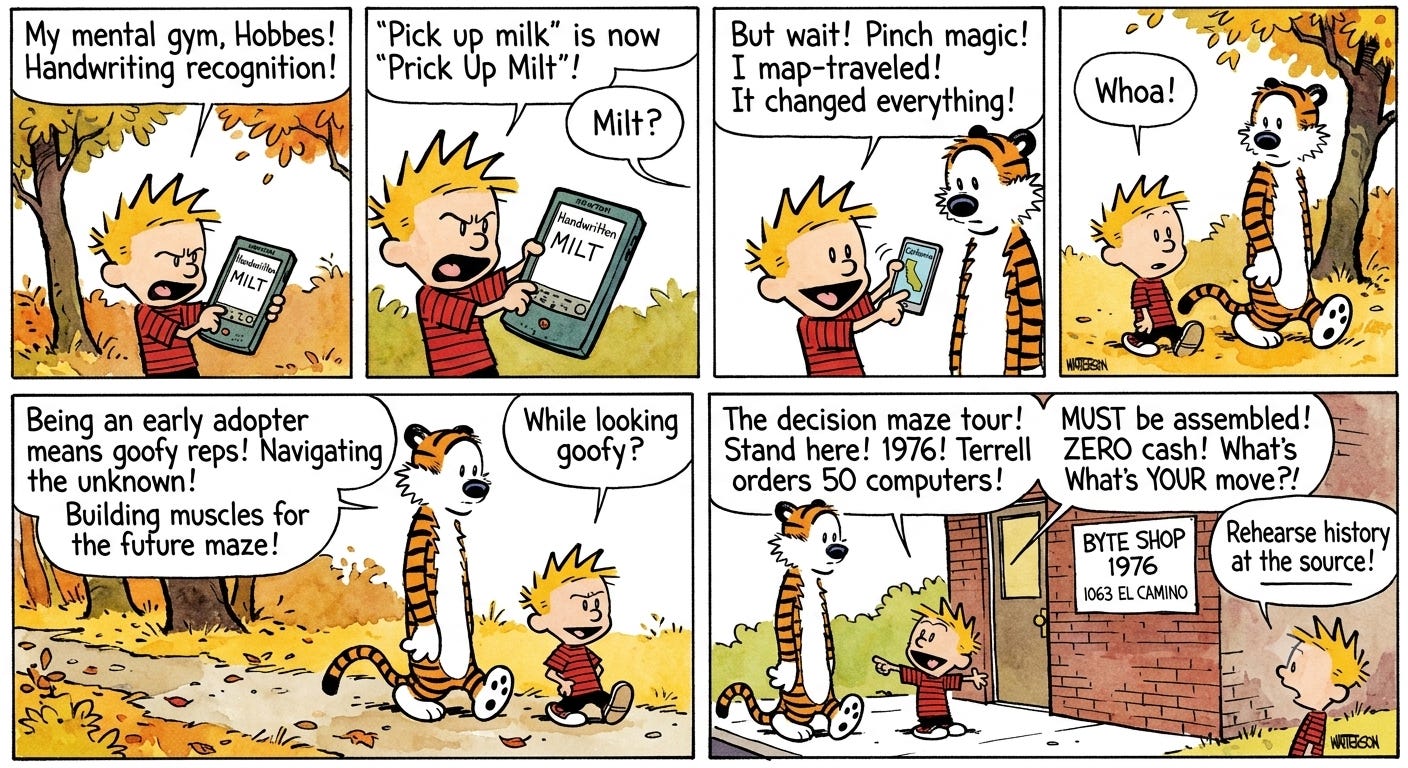
When I wrote Pick up milk as an early Newton user and got Prick Up milt, I knew handwriting recognition was at least a few years away from our reality. But the first time I pinched a map of the Bay Area and saw California, I knew that phones would not be the same again.
The life of an early adopter is not easy. It’s been ridiculed, often accurately, as living on the bleeding edge. But while often frustrating, I embrace this liminal phase of not quite predicting the future but witnessing a possibility. What would it be like if this new technology were widely adopted? What pathways and bottlenecks stand in the way?
Human desires are relatively constant but they manifest themselves differently in different futures. By imagining myself as a MySpace user, I could see they wanted to express their profile with their own chosen backgrounds of their favorite musician or movie star. But they did not know how, and so we invented CoolChaser, which made it all easier.
As I explored the world of browsers and extensions, I could see they opened up new ways of automating tedious, repetitive work. And when I glimpsed that FarmVille was taking over Facebook, I could sense the players’ frustration in mindlessly scouring their newsfeeds for game bonuses they may have missed. Could a Snag Bar be what they desire?
What makes the future the future is that it’s different — a little alien, unknown. Building for it means exploring an idea maze where most paths quietly dead-end. Because that future is still illegible, only a strange few adopt early — and the builder’s real work is how to bring everyone else on board. All while nimbly navigating where technology is taking us all.
What new problems and decisions will users and builders face there? Playing with gadgets is like going to a mental gym, building muscles for a future we are co-creating.
Lately my newest gadget has no hardware at all. I’ve been playing tangles on Trove (add me as @noblewillow): two-minute dilemmas with no obvious right answer. You choose, and the choice shows you a pattern in your own judgment you couldn’t see from the inside. It’s the same rep I’ve been doing for thirty years, just pointed the other way: instead of rehearsing what future users might decide, I’m discovering what I actually decide. Turns out the future isn’t the only illegible territory. There’s one even more unfathomable: me.
Just as gadgets are time travel devices, tangles are time travel to a possible you. It oddly feels like a warm-up: gadgets let me witness the future, but tangles let me rehearse for it.
Which is why, when a friend suggested my nascent Next Small Tours shouldn’t narrate Apple stories in the places they happened — that it should also drop visitors into the tangles and tough business decisions themselves — it landed instantly.
Imagine standing on 1063 West El Camino in Mountain View: it’s 1976, and Paul Terrell of the Byte Shop has just ordered 50 computers — but only fully assembled within 30 days, something you’ve never done and can’t afford to do. What’s your move? Decide first, then hear what Jobs and Woz actually did. A new kind of personalized walking tour: rehearsing decisions at the very spot they were made.
I don’t know if tangles are the future. But knowing was never the early adopter’s job. The job is to be there early, doing the reps.
"The builder’s real work is how to bring everyone else on board."
Thank you for being the best early adopter... I shall get to work with the above!! ^
As a full-blown technophobe, I greatly admire early adopters. We need more folks like you!