
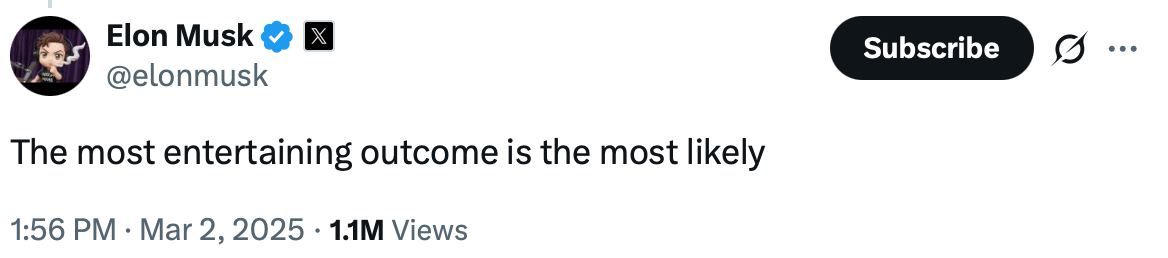
Nobody could tell you what would happen when Trump’s 48-hour ultimatum on the Strait of Hormuz expired. (He postponed it, claiming “good and productive” talks. Iran denied any talks and said he retreated “out of fear.” You can’t make this up.) The most powerful military in history launched a decapitation strike on Iran during nuclear negotiations. Iran’s counterpunch turned out to be closing a 21-mile-wide waterway.
Every development has the structure of a punchline: unexpected, but retroactively legible.
Stephen Wolfram has a name for this: computational irreducibility. Most complex systems can’t be shortcut. You can’t skip ahead. You have to run every step to see what happens.
This is also true of startups. And I think it explains something about where to build that nobody has quite named yet.
The Sommelier Problem
How much of what feels opaque in your life is genuinely complex, and how much is defended by someone who benefits from your confusion?
The sommelier tells you that you need years of training to distinguish a good Burgundy from a great one. The vocabulary is deliberately opaque. And blind tastings, the one context where expertise gets tested, repeatedly embarrass the experts.
Wine isn’t hard to understand. It’s defended. The gatekeeping vastly exceeds the actual difficulty.
Now compare that to nutrition science. For decades, the establishment said ice cream is a guilty pleasure. But buried in the data, there’s a persistent signal that ice cream correlates with better metabolic outcomes. Not because it’s a health food, but because the food matrix (the interaction between fat, protein, sugar, and fermentation in a whole food) does things that the “nutrition label” framework can’t encode. The signal is real, replicated, and ignored, because it doesn’t fit the paradigm.
That’s genuinely invisible. No formula captures it. You have to run the experiment.
Two kinds of opacity: a locked door and a maze.
A diagnostic: whenever you hear someone invoke “taste” as an explanation (this founder has great taste, that designer just has an eye for it) ask which kind they’re pointing at. Sometimes “taste” signals genuine complexity the person can feel but can’t name. Worth digging into. But sometimes “taste” is just the sommelier defending the gate. The first is a prospecting signal. The second is noise.
Four Stories About Mazes
I’ve built three products that worked. It took twenty years to understand why they worked, and why an earlier company, with more money, didn’t.
The Like Button I Didn’t Build
In 1998, I raised tens of millions for ShoppingList, built on an insight ahead of its time: people would research online and buy offline. We aggregated sales and deals from retailers so you could compare prices before driving to the store. The dotcom world was convinced everything was moving online. I was right that they were wrong.
We spent millions on radio campaigns and AOL partnerships. We hired sixty people. Revenue never hit $500k.
What would I do differently? Build a like button for a user’s favorite sale item that then went to their Shopping List!
That like button would have been the atomic unit our product needed. It would have served the user (bookmark this deal), made the invisible visible (which sales matter), and created growth dynamics (what’s popular, who finds the best deals). One product decision would have defined the vocabulary of online-to-offline shopping.
Instead, we paid AOL to show our content on their platform, in their language. We had the right insight but never built the move that would have made us the ones defining how the space became legible.
A few years later, Facebook did exactly that, for social connection. The like button, the friend count, the news feed. They defined the units of an invisible space, and those units became the vocabulary everyone else had to use.
The lesson: finding the invisible space isn’t enough. You have to build the product that defines how it becomes legible.
The Product That Named Itself
CoolChaser started as a failed social search engine. I convinced a friend to lend me his domain, url.com, which got thousands of visitors a day. That’s when I noticed something in the search logs: an outsized number of queries about “myspace layouts and backgrounds.”
I was a 40-something who didn’t have a MySpace account. But I followed the signal and discovered millions of teenagers desperate to customize their profiles, trapped behind a form that expected them to paste raw HTML code.
The incumbents all worked the same way: pick a static template, copy the code, figure out where to paste it. We built a browser extension that converted clicks into code automatically.
Then Hannah Montana wallpapers exploded. I couldn’t have predicted it. Teenage trend dynamics are computationally irreducible. I had to run the experiment to find where the energy was.
CoolChaser didn’t just serve the need. It defined what “customized” looked like on MySpace. Our templates, our trending page, our search categories: these became the default. We didn’t enter an existing market. We built the product that defined the rules of a new market.
The Verb That Became a Noun
I bought Thread Reader mid-spin. To unroll a thread, you replied “@threadreaderapp unroll” publicly on Twitter. Everyone watching saw you use it. Distribution baked into the product.
But the deeper thing was what happened to the word “unroll.” It started as a verb. Then people said “did you see that unroll?” A copycat tried “compile.” It couldn’t get traction because the vocabulary was set.
Our highest achievement, small as it sounds: power users started calling a thread itself “an unroll.” The product’s name colonized the noun. Every person who said “unroll” was propagating our framework without our involvement, teaching people a concept that didn’t exist before our product.
Language is the cheapest, most persistent distribution channel ever invented. We built the product that defined the language.
The Community That Controversy Built
The Snag Bar shows the full arc in compressed form.
FarmVille, 2009. Sixty million people pretending to be farmers. The game was deliberately grindy: manufactured friction to sell shortcuts. A locked door. We built a tool to collect all your bonuses with one click.
We were wrong about what we were building, in the best possible way.
The bonuses included gifts you could send to friends. Every Snag Bar user suddenly had more to share than anyone else. Their friends noticed. More users meant more gifts, meant more value, meant more users. We’d cut through Zynga’s locked door and stumbled into a genuine maze: social dynamics of reciprocal gifting that nobody fully understood.
Then: some players accused Snag Bar users of cheating. For a single-player farming game! That controversy strengthened the community. It created an in-group identity. The name “Snag Bar” was coined by our users. We lamely named it “FarmVille Bonus Snagging Toolbar.” They gave it the name that carried the identity.
Then the status layer emerged. Users with rare items (limited foals, seasonal Easter eggs) could gift them to community members and be recognized for it. A positional economy formed, denominated in units that only existed because of our product. People competed to be the most helpful. The most active volunteered to be our moderators.
Come for the tool, stay for the community, and for the status the community conferred. We built the product that defined the status.
The Playbook Nobody’s Named
What’s the pattern?
It’s not “find a market, build an MVP, iterate to product-market fit.” That works when the rules are known. The most interesting opportunities are in spaces that don’t have markets yet, because nobody has defined the units.
Distinguish locked doors from mazes. If the complexity is mostly defended, if “expertise” is really gatekeeping, AI will blow it apart. Don’t build there.
This isn’t about building a market from nothing. The demand is real. It’s just invisible to the current framework, waiting for someone to give it a name.
The opportunities are in genuine illegibility: products and experiences we don’t have names for yet. An open-world walking tour that isn’t a tour. Software that assembles itself on the fly for a single task, then dissolves. Tools that get sharper the more people use them. Social networks for AI agents, like Moltbook (a platform where agents interact and transact with each other), a category that was invisible until someone built it and suddenly everyone could see it. Before Uber, getting into a stranger’s car was invisible as a market: not because nobody wanted it, but because regulation, trust, and social norms made it unthinkable. Uber defined the units (star ratings, fare estimates, driver tiers) and an invisible market became legible overnight.
These aren’t better versions of existing categories. They’re new categories, waiting for someone to define the units.
Sometimes you find both. You cut through manufactured friction and discover genuine complexity behind it. The best opportunities are where a locked door hides a maze.
Your product decisions are definitional decisions. When you build in a space nobody can yet see clearly, you’re not just solving a problem. You’re defining how it becomes legible: what gets measured, displayed, compared.
Before Twitter, influence was invisible. Twitter invented the unit: the follower count. Before Facebook, your social life was invisible. Facebook defined the units: friend counts, likes, the news feed. These aren’t discoveries. They’re definitions, arbitrary product choices that became the standard. Whoever defines the units controls the ecosystem.
Ask yourself: what is the atomic unit of my product? What will users name? What will they count, compare, compete on? That unit determines whether you build a business or a commodity.
Let the status layer emerge, then nurture it. Every startup that defines the vocabulary of a new space will see status dynamics form on top. The Snag Bar’s gift economy emerged from community dynamics. Thread Reader links becoming social currency wasn’t planned. But once these dynamics appear, they are the moat. The status people accumulate in your system is denominated in your currency. They can’t take it with them.
Here’s the thing: every successful startup is an escape from someone else’s legibility into your own. You build something real. Your framework becomes the standard. You define what counts. You went from breaking through someone else’s locked door to building your own maze, one that’s genuinely complex, because communities and network effects are themselves computationally irreducible.
The Maze Ahead
AI is kicking in the locked doors. Every gatekept expertise that was mostly theater is getting exposed.
But AI is not dissolving genuine complexity. It’s creating more of it. More tools talking to each other, more unexpected interactions, more outcomes nobody modeled.
Two things are happening. First, AI is opening up invisible spaces at an order of magnitude greater rate than any previous wave. Social media took a decade to go from “what is this?” to “followers, likes, shares.” AI is cracking open dozens of domains at once, each one an arena for someone to define the units.
Second, AI collapses the cost of contribution. Most people won’t write a review or edit a Wikipedia article. But everyone can answer questions. AI can interview knowledge out of people and stitch it into something structured. The invisible-to-legible flywheel can now spin in domains it couldn’t reach before.
But here’s what AI can’t do: decide what matters.
AI can measure anything. It can rank, sort, score, and optimize along any axis you give it. What it can’t do is choose the axis. Choosing what to measure in a new space, deciding that “followers” is the unit of influence, that “unroll” is the unit of readable content, that rare foals are worth competing over: that’s an act of judgment about what humans care about. It requires understanding desire, status, identity, community. An algorithm can optimize a status hierarchy once it exists. It can’t author one from nothing, because the choice of what counts as status is not a pattern in the data. It’s a gut feeling. It’s intuition. It’s visceral. It’s a bodily reaction.
The best founders are the ones who get to name what counts.
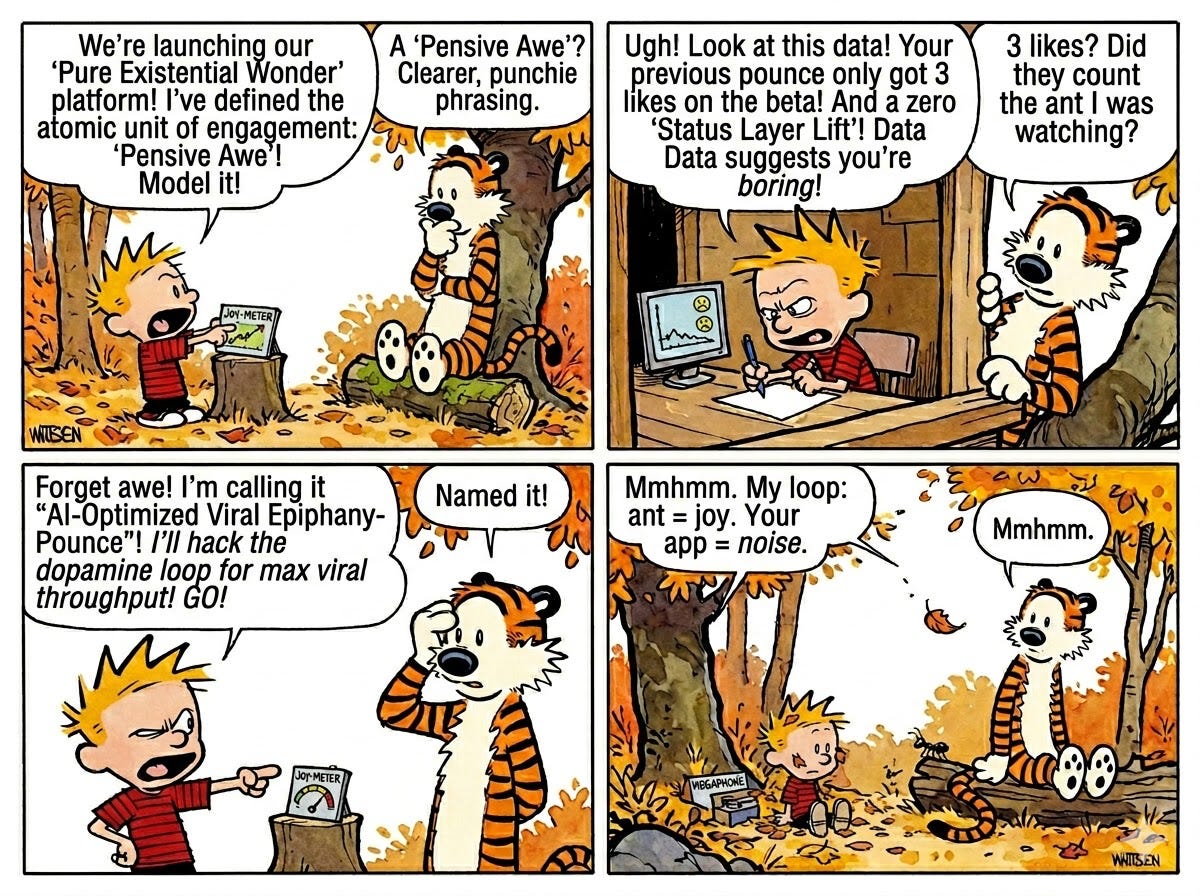
Try the Unnamed Playbook
I turned this essay into a set of interactive tools for Claude (or any skill supporting LLM). Five diagnostic interviews you can run on your own startup:
/locked-or-maze — Is your market’s complexity defended or genuine?
/find-your-unit — What’s the atomic unit of your product? What will users name?
/taste-test — Is “taste” pointing at real opportunity or just gatekeeping?
/status-layer — Where are status dynamics emerging in your community?
/name-the-invisible — You sense something but can’t articulate it. Let’s find the shape.
To install: Download the skill file, save it as a .md file, then go to Claude → Settings → Customize → Skills → Upload.
Then start a new conversation and type /locked-or-maze or just describe your startup. Claude will know what to do.
Thanks to Christin Chong, PhD , Chris Wong and my friends at Sample App for testing this out - it was really super fun!
…envisioning a future of robot sommelliers…
It's a really deepful and insightful article, deserves to read repeatedly. I will try the skill.