
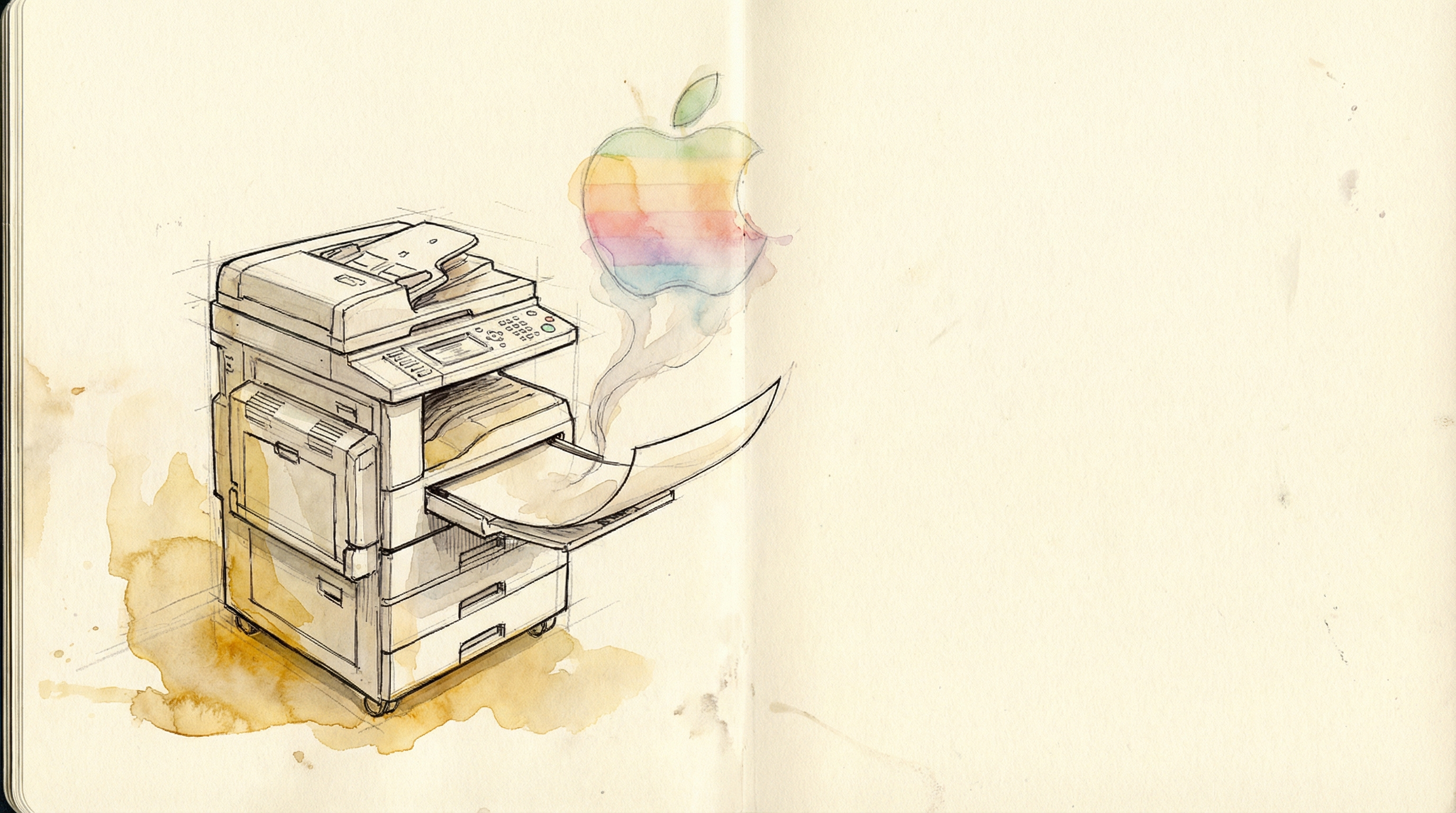
Some geeks recall fondly their times spent in bookshops. I spent my teenage years in copy shops.
In a harshly fluorescent-lit room in Singapore, machines zipping their own fluorescent lights, I copied the photocopy of the photocopy of Beneath Apple DOS. That was my initiation to a secret guild.
Tomorrow, Apple turns 50. I've been writing a somewhat-daily newsletter about Apple for roughly the same number of days.
Seven months ago, I wrote a letter to myself committing to build an Apple Library — a database of stories extracted from every major book about the company. Tagged by dates, locations, characters, products. Maybe, someday, the foundation for a walking tour of Palo Alto, where every boring office front hides decades of drama underneath.
Then life happened. Singapore twice for family. New York for an AI conference. Four months, zero newsletters.
But walking along Manhattan's High Line, I kept pointing my camera at buildings and asking ChatGPT to tell me something interesting. In Singapore, walking with my mother through Rifle Range Nature Park, I was thinking about presence — what happens when you stop scrolling past information and start being with it.
Three things congealed: a near-daily cadence to build momentum. The newsletter as experiment in a medium that doesn't have a category yet — not "reading news," not "writing with AI," something in between. And if I ever build the walking tour, it shouldn't be a guided checklist — it should be an open world, like Breath of the Wild, where the AI responds to curiosity instead of steering you through checkpoints.
In January, I published eight newsletters in fifteen days.
Here's what the process looks like.
I sit down with Claude Code and say: what happened, and what does our library say about it? The AI searches a SQLite database — 29 books extracted, over 6,000 stories, geocoded to more than 17,000 locations. It finds the historical rhyme. I push back. I sharpen. I redirect.
"ROKR is overdone by us," I said when Claude suggested the Motorola parallel for the fifth time. "Local on-device inference is the Apple long-term position." That push turned a stale partnership story into a piece about the nine-year Neural Engine infrastructure play.
"No one else has this twin leverage" — a phrase I landed on mid-session that became a named analytical pattern and shaped every supply chain story after.
"What can Siri do for me that no other app can?" — a reframe, born from interrupting Claude mid-pitch, that became the thesis of the most recent issue: privacy was the lock; Siri is the only key.
The machine does the research. I do the whimsy. The newsletter is the residue of that collision.
Things broke beautifully.
Steve Wozniak's memoir: the parser read three HTML files as three chapters. 52 stories. We fixed the splitter. 185 stories. Same words, different cuts, 3.5x the yield.
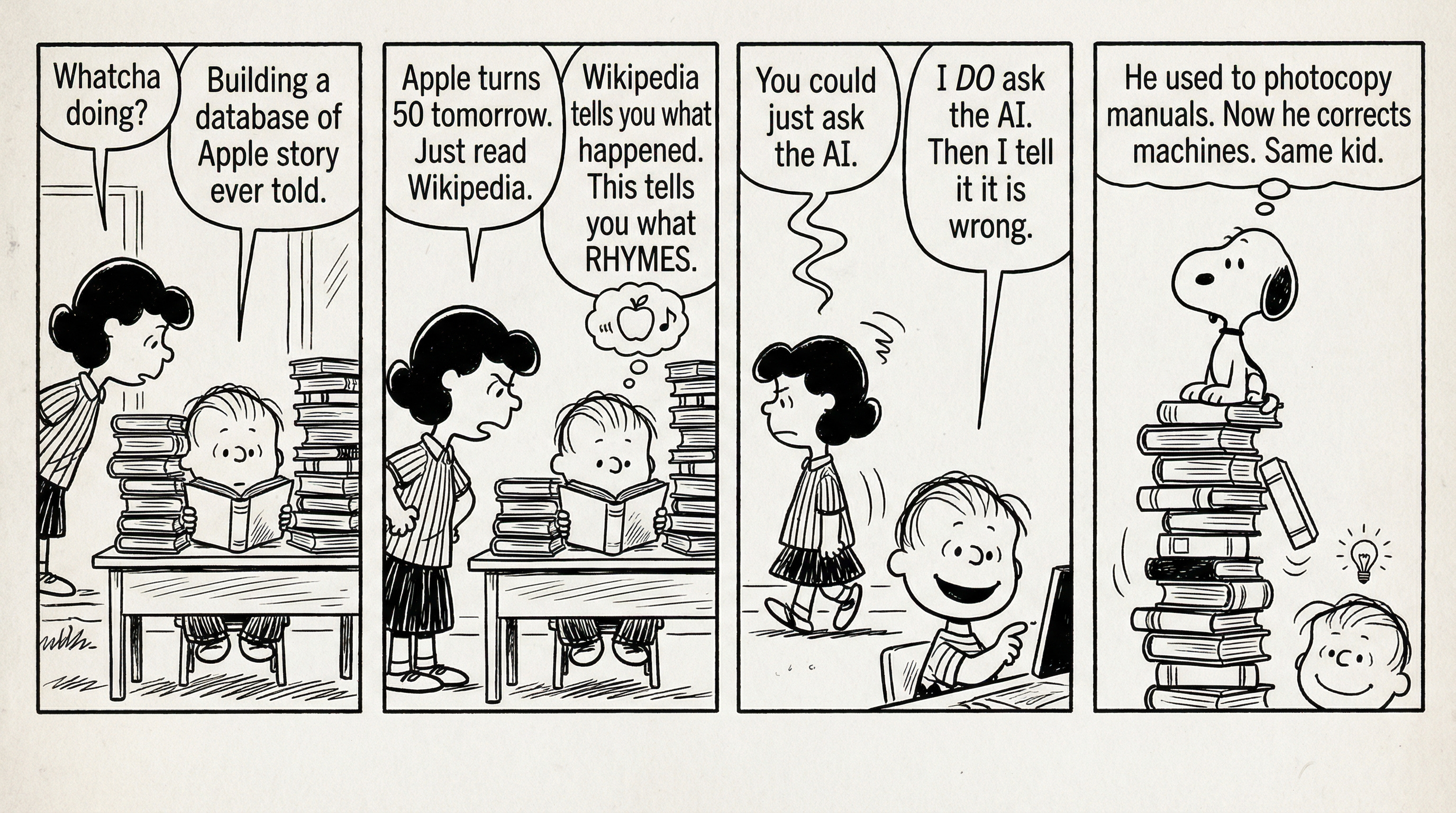
A Peanuts-style comic strip, requested on a whim, was so charming it became a permanent feature of every issue after.
Image pasting to Substack — generate, copy, switch to Chrome, pray — failed for the dozenth time. I snapped: "Can you think ground up how we can improve this?" 666 lines of Python reverse-engineering Substack's undocumented API later: one command, no browser, no prayer.
And writing "Chekhov's Gun" about Apple's privacy architecture, I searched the database for Apple's role in creating ARM — one of the most consequential partnerships in Apple's history. Nothing. Apple was basically responsible for ARM's existence, and the story wasn't in any of the books we'd extracted. The database taught me what it didn't know, and pointed me to which book to extract next. (I'm reading The Everything Blueprint now. Just got it extracted.)
In March, I went back to Japan. Myoko Kogen for skiing. Zenkōji temple in Nagano. The Setsugekka train through snow country.
I kept publishing. "Eight Slots, Two Dies" from a ryokan. "Party of One" between ski runs. "Chekhov's Gun" on a travel day. Different from September's burst — from "The Boring Revolution" and the bingo card I called a failed experiment. This was a practice.
At Zenkōji, I used Claude as a voice guide. The walking tour prototype, live, in the field.
It misidentified the main hall. Kept steering me to the okaidan tunnel like a checklist. No sense of time, no way to share a photo without exiting the conversation. Not great.
But the failure was the gift. GPS-anchored content, not vision-based guessing. Camera-first, like Snapchat. A single ambient companion. I couldn't have learned this from planning.
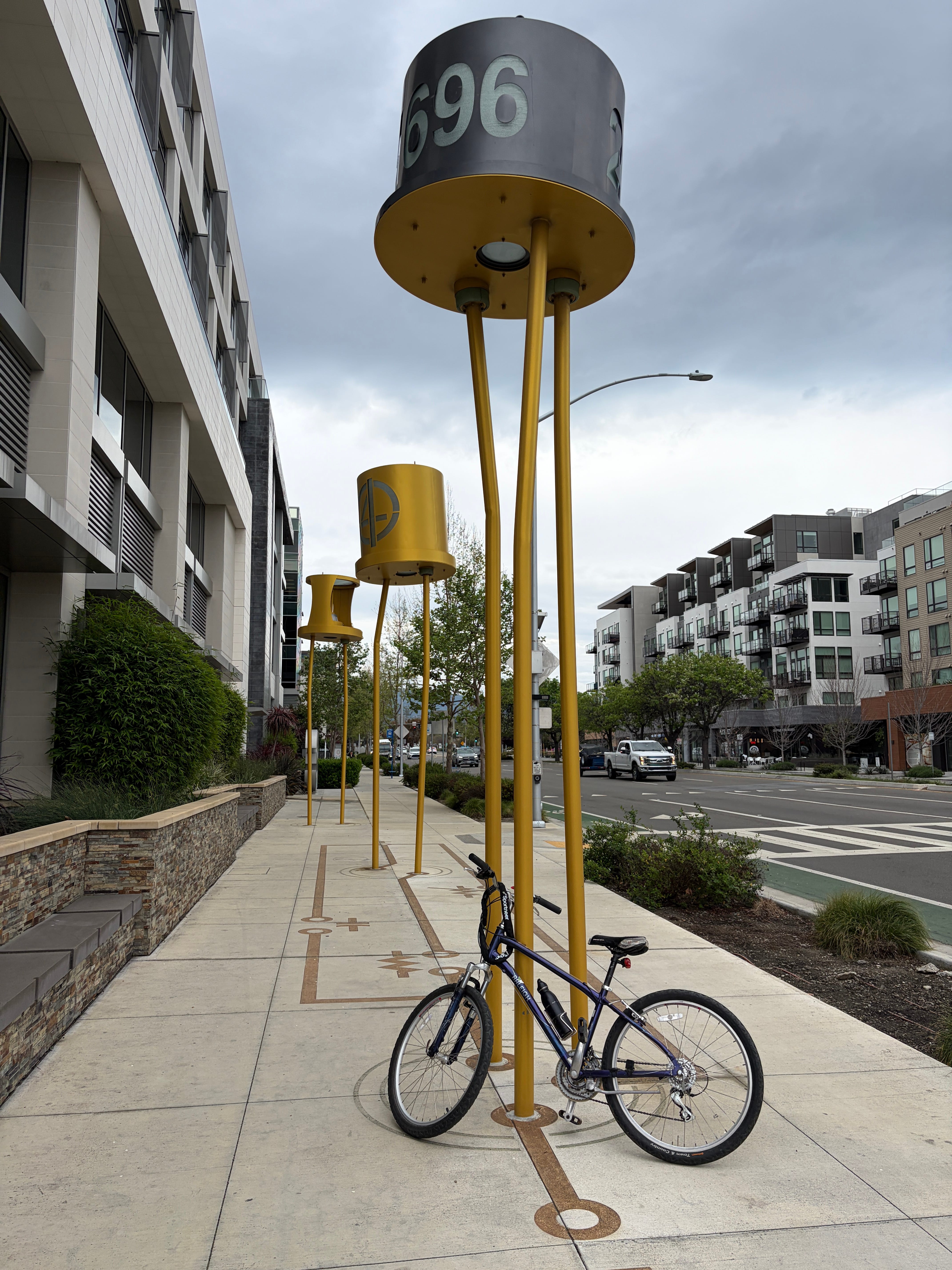
The project keeps spilling beyond Apple. Yesterday I published "Refractions" — comparing William Shockley with a modern-day tech bro, tracing how a genius who couldn't keep people spawned the entire Silicon Valley ecosystem. That essay grew from the Apple Library research — Malcolm Harris's Palo Alto, the Fairchild genealogy, walking tour conversations about what stories hide under suburban surfaces. Today I cycled to 391 San Antonio Road in Mountain View to visit the Shockley Semiconductor sculpture.
The library isn't just producing newsletters. It's sending me places.
I'm writing this on an M4 MacBook Air. Maybe a twentieth the weight of my first Apple ][. Next to it, my iPad Pro and my just-feels-right iPhone Air. I switch between them without thinking. Between sessions I'm chatting with Claude about the Strait of Hormuz, or planning a scenic train ride, or transcribing a podcast, or arguing about whether Kurzweil will win his long bet.
Fifty years ago, two guys in a garage were hand-soldering circuit boards for a computer club. The word "startup" didn't exist. "Personal computer" was an oxymoron.
What I'm doing now — conversing with an AI about the history of the company that built the machine I'm conversing on, pulling from 29 books to connect today's news to forty-year-old decisions, generating comic strips, publishing with a single command — would have been incomprehensible to them. It would have been incomprehensible to the teenage me, sweating in that copy shop.
And yet it feels continuous. The same curiosity. The same secret guild. The same click when a database query surfaces a rhyme I didn't expect, or a thesis snaps into focus, or a prototype fails in exactly the right way.
Apple's story is still not done. The last decade — as I discovered reading Apple in China — is just as fascinating as any other. Not as much personal drama as Jobs's reinvention, but so much more massive. Billions instead of millions.
My story with Apple isn't done either. Thirty-some more books to extract. A walking tour to build. A practice that compounds.
Seven months ago I wrote: "The next five weeks aren't about building the complete library. They're about discovering what this library wants to become."
Still discovering.
Happy 50th, Apple. Here's to the next fifty.
chao
(an earlier version of this was also cross-posted on Apple's Story)
Chao, it's hard to believe that it's been a HALF CENTURY! Time sure flies. Thanks for the reminder.