

University and Bryant.
A semi sat at the red, signaling right.
My walk sign flipped first. I stepped off the curb.
A beat later, his light went green, and the cab began to swing into the turn — slowly, heavily, toward me.
Behind me, my friend stopped.
Don’t gamble with your life. I’m not crossing.
I kept walking.
A second later, he came running after me.
I have been trying to write about that moment for weeks, which is usually how I know I am in trouble.
The words keep arriving dead:
Think in flows.
Feel the second derivative.
Don’t confuse the snapshot with the trajectory.
All true. None of them the thing itself.
The moment itself was not abstract. It was ten feet of asphalt and a truck big enough to flatten me into a Nextdoor post.
My friend saw the truck.
I saw the truck too. But I also saw the stage it was in.
Starting from zero. Turning through a tight radius. A driver who had already looked at me before his light changed.
That did not make the truck safe. Nothing makes a semi safe.
But it made the next few seconds different from the picture my friend was reacting to.
He saw a still image: massive vehicle, crosswalk, me.
I saw a short movie: truck beginning from rest, constrained by the turn, driver already aware of me.
The still image said danger.
The movie said I had time.
A few days later, a friend sent me a screenshot of a fake LEGO set someone had generated with AI.
Pablo Escobar: Thinking Alone.
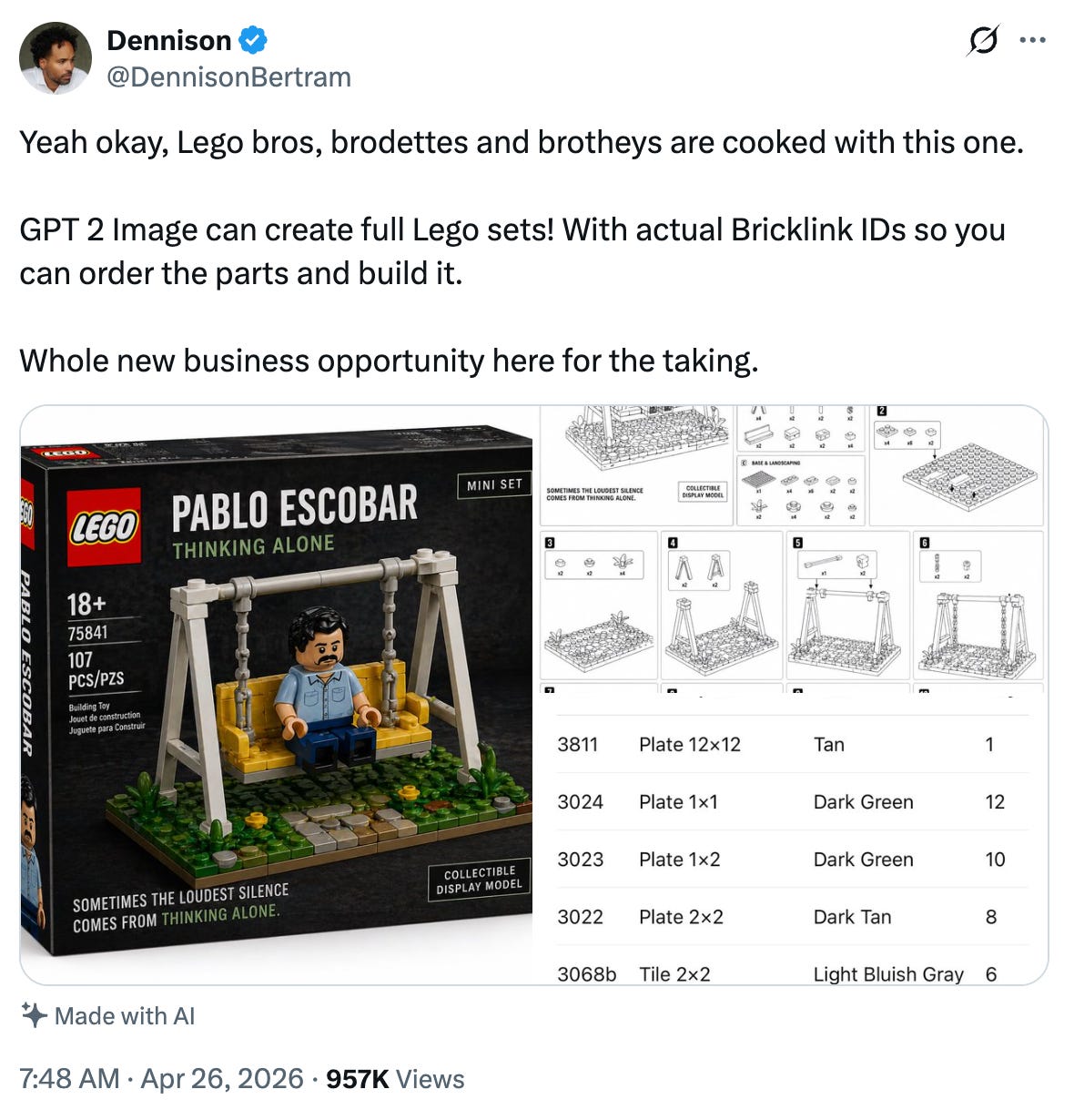
A tiny haunted minifig on a yellow swing. The solemn product photography of nonsense.
The poster wrote:
Whole new business opportunity here for the taking.
My friend was not buying it.
Comments already say it hallucinates bricks. The key is to find ideas that don’t require precision. It sucks to make production-ready tools.
She was right.
The bricks were dream logic with studs. The set number was invented. The swing might not survive gravity.
As a product, it was broken.
But I caught myself making the same move I had made in the crosswalk.
I saw the stage it was in.
The wrong first question was: Can this AI make a perfect buildable LEGO set?
The better first question was: Can this fake box make someone want a real one?
One asks whether the factory works. The other asks whether anyone cares.
A fake LEGO picture can't be built.
But what can it tell you about what someone wants?
So make a hundred.
Your childhood home. Your dog as a medieval knight. The bedtime story your kid made you read three nights in a row. Steve Jobs alone in the garage. Grandma’s kitchen, 1994.
Most will be dumb. Good. Do dumb things while it’s cheap.
Put them in front of people and watch.
Which ones get shared?
Which ones make people ask, “Can you do mine?”
Which ones produce the fatal sentence: “Wait, I would actually buy this.”
The signal is not in the bricks. The signal is in the pull.
And in whether the world is leaning toward the joke this month or away from it. Six months on, the same image might die as slop.
Then the questions change.
Suppose the fake boxes work. Suppose people keep asking for them.
Now the hallucinated bricks matter. But not all errors are equal.
A wrong shade of blue is fine. A floating brick is fatal. A 900-piece model delights obsessives and terrifies parents. A 120-piece model might be giftable, shippable, and finishable before a child loses interest.
You don’t discover that by declaring “the AI hallucinates bricks” and walking away.
You discover it by turning desire into objects and watching where reality pushes back.
And reality pushes back hardest where the AI is weakest: physics.
It can render a swing that looks like a swing. It cannot tell you whether the swing will hold a minifig in actual gravity.
At some point, the hallucination has to become a draft, and something real has to check it.
A real parts catalog. A 3D constraint model. A check against gravity, cost, color, availability.
The dream needs a bridge to the brick.
That bridge is where someone has to do real work.
Maybe the next version is not AI generates a perfect LEGO set.
Maybe it is upload a photo, get a render, pay $9 for a parts list and PDF instructions.
No inventory. No warehouse. Just enough reality to test whether the person who loved the fantasy still wants it on a Saturday afternoon.
Then a curated kit. Then pre-sorted bags. Then a marketplace of fan-designed micro-sets.
Then maybe it dies because nobody wants to assemble anything, or the support burden is absurd, or the moment passes and the whole thing only worked as a meme.
Fine.
That is a useful death.
It died in motion.
This is the part that is easy to caricature.
I am not saying every broken prototype is secretly wisdom.
Some things are don’t work.
But the flaws may not be the flaws that matter yet.
The fake LEGO box does not need four nines of accuracy.
It needs maybe one nine to test the joke.
Two to make the concept plausible.
Three for a builder to stop rolling their eyes.
Four to ship without drowning in customer support.
Most of the work is between the nines.
Most people see the first nine, compare it to the fourth, and declare the whole thing fake.
Which it is.
But fake at the right stage is not the opposite of real.
Sometimes it is the path to real.
This is where the snapshot lies.
The snapshot says: this LEGO set is fake.
The flow says: yes. What can the fake version teach us before it has to become real?
The snapshot says: this prototype doesn’t scale.
The flow says: of course not. It is trying to discover the workflow.
The snapshot says: this startup has tiny revenue.
The flow says: look at the weekly growth rate, and the market it is growing into.
The snapshot says: that semi is entering the crosswalk.
The flow says: from zero, through a turn, with eye contact, inside an intersection whose rhythm I had already felt.
The snapshot is not wrong.
That is what makes it dangerous.
It is true, but incomplete.
The longer I spend around startups, the less impressed I am by visions.
Visions are cheap. Everyone can describe the castle in the sky.
The harder skill is seeing how the crude thing gets better.
What is the ugly first version good enough to test?
What comes back? What breaks? Which breakages matter, which are just aesthetic, and which ones reveal that no one cared in the first place?
You do not leap from hallucination to factory. You build the loops that make the hallucination less fake.
A picture becomes a demand test. A demand test becomes a prototype. A prototype reveals constraints. Constraints shape the product. The product creates behavior. The behavior sends back information.
The loop tightens or dies.
And sometimes, if you are lucky, the larger world starts moving in the same direction.
The driver sees me. I see that he sees me.
A meme gets posted. People laugh, share, ask, complain, preorder.
A tiny startup reports revenue. The number is small, but the slope has changed.
This is one reason I like being around folks like you. We do not always see the same flow. One person sees the hallucinated brick. Another sees the demand signal. Someone else sees the cultural current. Someone else sees the supply-chain trap. The useful conversation is not deciding who is right too early. It is letting the object rotate between us until the next experiment becomes obvious.
The interesting thing is the object, and the information moving around it.
The truck is not just mass. It contains a driver, and the driver contains a model of the crosswalk.
The LEGO image is not just pixels. It contains a fantasy, and the fantasy produces signals.
The startup is not just revenue. It contains a theory of growth, and the growth rate tells you whether the theory is alive.
This is why “second derivative thinking” sounds so bloodless to me, even though I keep reaching for it.
What I mean is closer to a sequence of questions:
Where is the thing?
How is it moving?
What is making it move?
What would make it speed up, stall, or stop?
What tiny experiment would tell us which story is true?
My friend in the crosswalk was not stupid.
He was sane.
There are worse habits in life than refusing to step in front of a semi.
My friend in the LEGO thread was not wrong either.
Hallucinated bricks are a real problem. Production tools really do suck to make. Reality has teeth.
But in both moments, I felt the same little tug.
Don’t freeze it there.
Don’t stop at the silhouette.
Ask what stage it is in.
A truck from a dead stop is not the same object as a truck at speed.
A fake LEGO box is not the same object as a production system.
A small startup growing fast is not the same object as a larger company going flat.
The snapshot lies by omission.
The flow tells you what to try next.
Thanks to Christin Chong, PhD, Kathy Ayers, Larry Urish and Rick Lewis for helping me figure what’s dead in the piece.
“The better first question was: Can this fake box make someone want a real one?” - i don’t know - my question is why are we making things we don’t care about beyond the possibility of capital?