
The dunking started within hours.
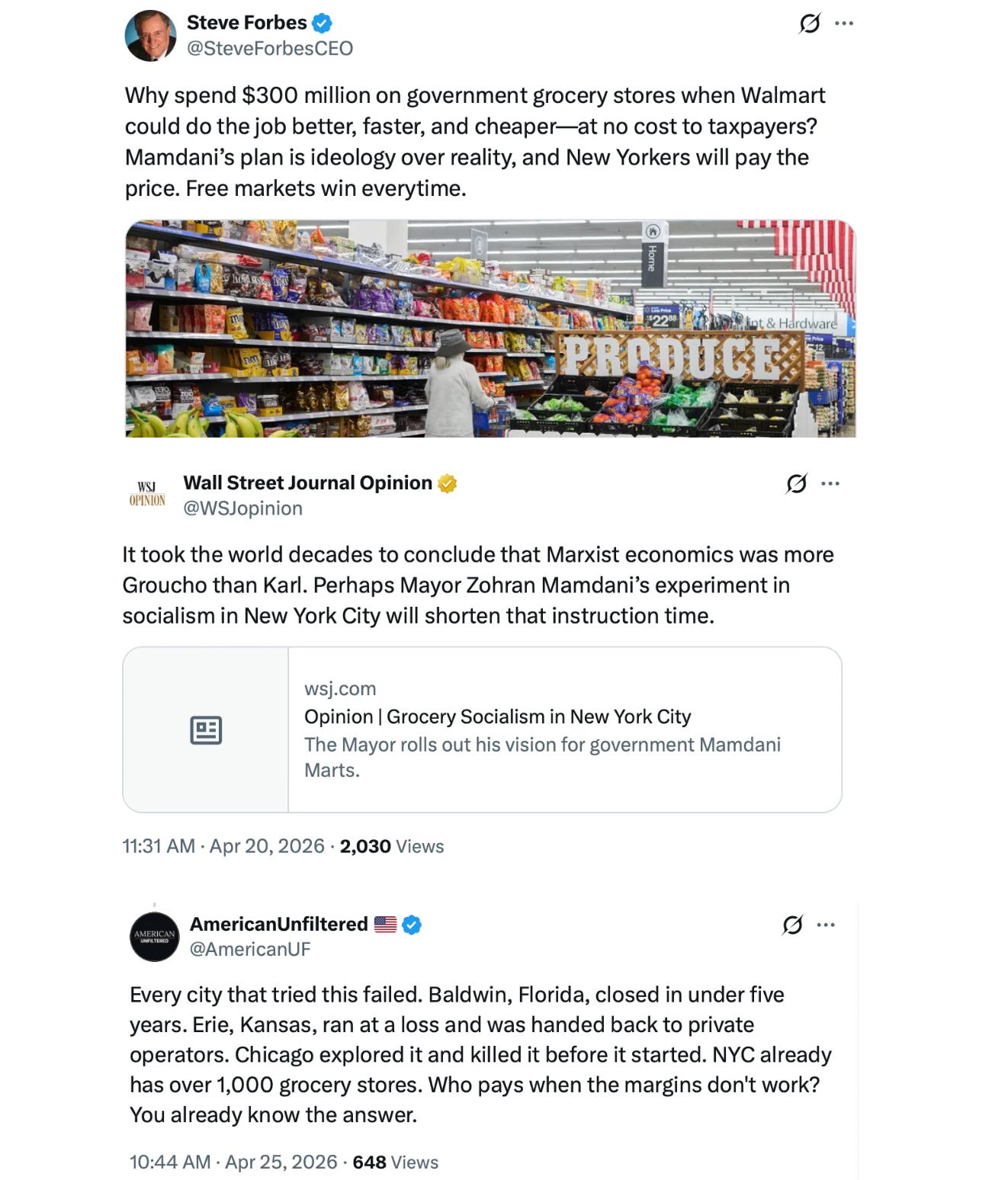
Maybe it’s right. City-owned grocery stores are exactly the kind of idea that makes economists reach for the fire extinguisher: low margins, brutal logistics, political incentives, and a long history of pilots that turn into cautionary tales.
The internet had decided what kind of story this was: socialism meets grocery margins. A municipal boondoggle with checkout lanes.
But when a consensus forms this fast, it just brings out the contrarian in me: if the obvious version of this idea is bad, is there a non-obvious version hiding inside it?
I should disclose: I have zero qualifications here. I’m a Palo Alto tech guy who teaches entrepreneurship and shops at Trader Joe’s.
But this is where my founder-brain wanders into rooms where it has not earned a chair. Show up in unfamiliar territory, ask the dumb questions, pattern-match from elsewhere. The whole game is bringing beginner’s eyes and a different toolkit.
So: if you handed me Mamdani’s $70M and said “make this work” — what would I do with it? I am not running for anything. This is just how a founder reads the news.
1 · The first dumb question
What problem are we actually solving?
Mamdani says “make groceries cheaper.” But cheaper for whom, by how much, compared to what alternative? You could hand $70M of subsidy to Walmart and call that cheap. That’s not interesting.
Sharper question: when does a low-income East Harlem family feel grocery prices most painfully? Probably not steady-state Tuesday shopping. The pain comes in the shocks — bird flu spikes egg prices, a shift gets cut, rent jumps, kid gets sick. The actual job isn’t “be slightly cheaper than Aldi every week.” The job is be the predictable backstop when things go sideways.
That reframe changes everything. Different goal, different design, different definition of success.
And — this is the part that surprised me — nobody in the consensus seems to have actually asked this question. Critics argued whether the plan would lower prices. Defenders argued it would. Neither asked what the plan was for. This is the most common mistake in startup pitches and apparently in policy debates too.
2 · What the patterns say
Where do sub-scale operators actually win? Three cases:
FairPrice, Singapore. One store in Toa Payoh in 1973. Took 25 years to build the warehousing arm. Today: ~50% market share and a real brake on grocery prices for the whole country. I shop there whenever I’m back in Singapore — last visit, my wife texted me to grab Tanakan tablets, 30% off. Compounding institutions start small and unimpressive. Five stores at once is the wrong move. One store with a path to scale is the right one.
Aldi. Doesn’t beat Safeway by being a smaller Safeway. Wins by carrying 1,400 SKUs instead of 30,000. Different format, different cost structure. Lesson for Mamdani: don’t run a tiny supermarket. Pick a format Safeway structurally can’t.
99 Ranch & the 13,000 NYC bodegas. Both prove sub-scale grocery thrives when it picks a different game. 99 Ranch wins on category density in Asian SKUs. Bodegas win on proximity, hours, prepared food. They falsify “scale is destiny.” The question is always which sub-scale format you’re inventing.
What do these cases show? Sub-scale wins only by changing the game.
3 · The Walmart gambit
Here’s where it gets fun.
The hardest part of grocery is supply chain. Five stores can’t match Aldi’s wholesale prices. NTUC built its supply chain over 25 years. Mamdani doesn’t have 25 years.
So: what do we have that they don’t, and what do they have that we don’t?
The city has: mission, capital, real estate, political legitimacy with low-income communities, and the ability to run transfer payments through retail. It also knows who needs help better than anyone else — SNAP rolls, Medicaid enrollment, school meal sign-ups, NYCHA tenant data. Walmart has to guess at this. The city already has the answers. What it lacks is supply chain scale.
Walmart has: the most efficient grocery supply chain in North America. It lacks urban retail access in NYC — has tried for years and been blocked at every turn.
The impolite move is: rent Walmart’s supply chain.
NYC owns the stores, sets the rules on labor and pricing, owns the customer relationship. Walmart provides wholesale procurement and distribution at cost-plus. This isn’t outsourcing operations to Walmart — it’s using their supply chain as infrastructure, the way the military uses Boeing for planes without becoming an airline.
Walmart gets revenue from a market they couldn’t otherwise access. NYC gets supply chain economics they couldn’t otherwise build. Neither party builds what the other already has. This is the cleanest version of partnership: complementary asymmetric strengths.
This is the wedge every startup looks for: asymmetric competition. NYC supermarkets have to maximize profit. Mamdani doesn’t. He’s optimizing for affordability and stability, not quarterly earnings. That’s not a weakness — it’s a different objective function entirely, and it’s exactly what creates space for disruption. You can’t out-Key-Food Key Food at being Key Food. But if you’re playing a different game, you don’t have to.
One bonus: only Mamdani can pull this off. A moderate Democrat partnering with Walmart gets eaten alive by the left. A democratic socialist mayor doing it looks like ruthless pragmatism — Nixon goes to China, except the China is Bentonville, Arkansas. Use the political asymmetry while you have it.
4 · The dream plan
So if you handed me the $70M and locked me in a room:
One store first. In the neighborhood with the sharpest mismatch between need and existing retail. Not borough balance — diagnostic clarity. Earn the next four.
150 SKUs, mostly staples. Not a tiny Safeway. A tightly-curated essentials operation.
Double SNAP at the register. Government can run transfer payments through checkout in a way private grocers structurally can’t. Every SNAP dollar becomes two. The store becomes the highest-value use of SNAP in the city.
Walmart wholesale partnership. Rent the supply chain. Mission belongs to the city; logistics belongs to whoever does it best.
Price buffering on staples. Eggs hit $12 during bird flu? Sell them at $4. Eat the loss, amortize across normal years. Only public balance sheets can do this.
Service integration. SNAP enrollment, school meal sign-up, WIC at the same location. The store as partial delivery mechanism for services the city already runs.
Transparency as a feature. Publish prices, costs, subsidies, contracts. Trust and pressure on incumbents are both downstream of openness.
And best of all? I wouldn’t spend $30 million on the first store. I’d spend $2 million (that’s 0.0016% of Mamdani’s $122 billion budget — a rounding error in a rounding error). Use one of the vacant storefronts the city already owns. Strip it, stock it, open it. A cheap and stable grocery needs to be frugal itself — you can’t run an affordability operation out of a hero project. Leverage the free publicity from the Twitter trolls and the WSJ editorial board; they’ve already made this the most-watched grocery store in America. Be humble. Learn from the experiment. The other $68 million stays in the bank until the first store proves something worth scaling.
Five stores in five years was the political plan. This is the founder plan: one store, distinctive format, rented supply chain, public-only mechanisms, open books. Different category of bet entirely.
5 · Why I bothered
I have no idea if any of this would actually work. Genuinely don’t. Maybe the consensus is right and the whole thing is a boondoggle. Maybe I’m missing twelve things obvious to anyone who’s spent a day in city procurement.
That’s not the point.
The point is the questions. What’s the actual job? What can I do that incumbents can’t? Who’s the unlikely partner I should rent capability from? What’s the smallest version that would teach me whether the bet is real? None of these required grocery expertise. They required willingness to probe without expertise and pattern-match from elsewhere.
The next time you find yourself handed a problem everyone dismisses as impossible, take on this smug probing persona. Ask dumb questions. Think about hidden goals, ecosystems, and structures that nobody else is thinking about. Sometimes the consensus is right. Sometimes it isn’t. The only way to know is to start digging.
p.s. if you laughed at this tech bro attempt at humor, or wondered what startup sessions with my NUS students are like, here’s our chance for a chat: https://appt.link/time-with-chao-VPJUZ3nZ/web-conference Wife is out of town and I could use some company - don’t be shy!
Chao, have you sent this to the mayor of NYC? Sounds like he could use you on this project!!!
…solving unsolveable problems at least means trying novel solutions, and the louder people fight something untried my spidy sense starts to sing and say hey why tf not…