
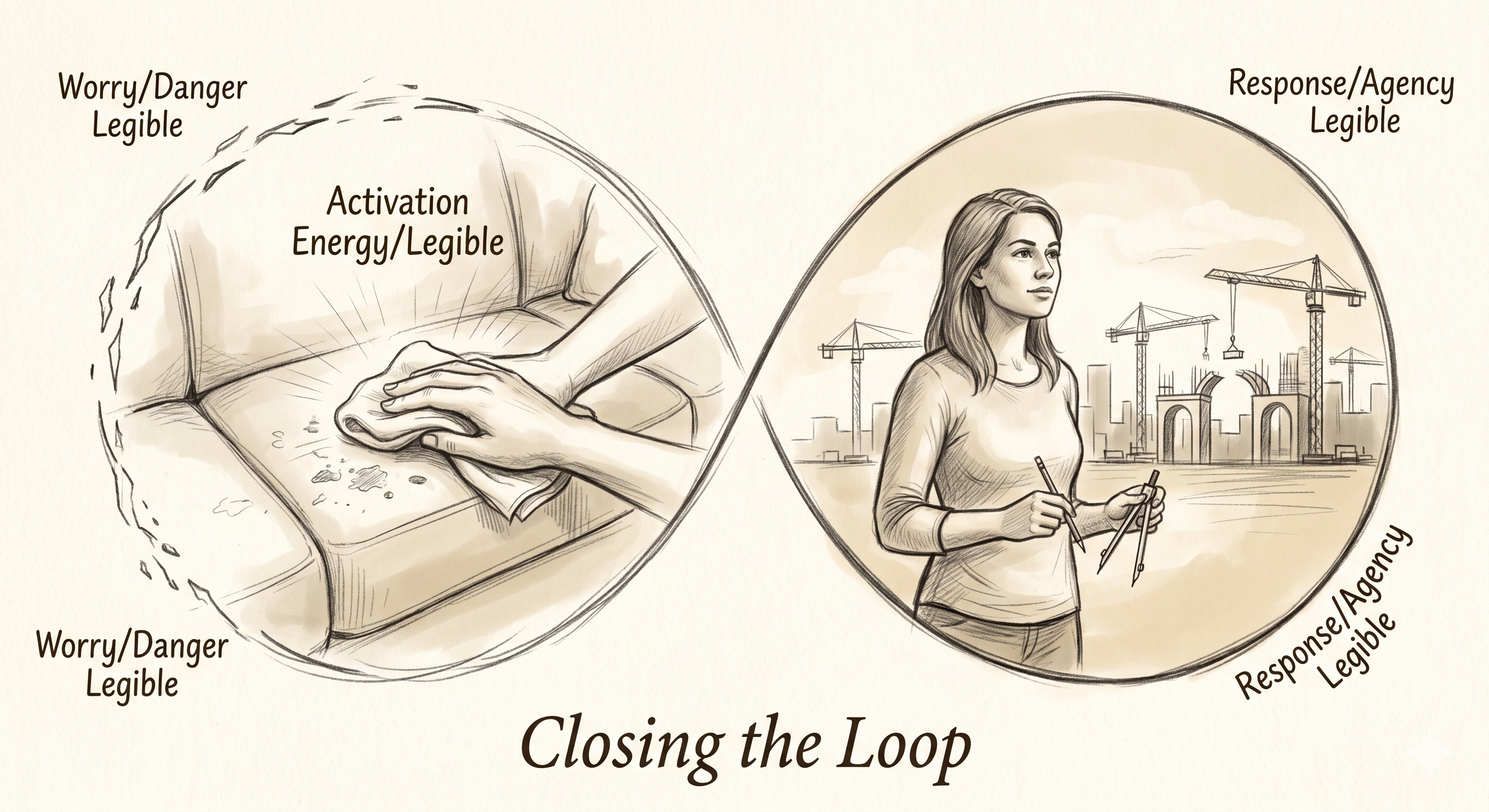
It’s a Tuesday after dinner. I’m on the couch, eight minutes into For All Mankind and wondering how they managed to age Joel Kinnaman yet again, and my wife comes and sidles up to me. At least that’s what I think she’s doing — until she stops, points at a spot near where my elbow rests, and says, “What is that? Who did that!”
I look. There’s a smudge. Then there are two spots. Then I’m seeing marks I’ve never noticed in three years of owning the sofa — a constellation of small disasters — a blood stain here, a chocolate speck there, a few unknown black and grey dots that could be anything. The sofa hasn’t changed. My evening has.
“Are you going to bring a microscope next?” I say. “Make me see all the microbes?”
She does not laugh.
She’s right. The marks were there. I’d chosen not to see them, without knowing I was choosing. She made them legible, and now I can’t unsee them, and there’s nothing I want to do about it at 9pm on a Tuesday. The information arrived without the agency to act on it.
Tomorrow morning those same marks won’t be anxiety. They’ll be a chore. I’ll get out the upholstery cleaner and take twenty minutes and they’ll be gone. Same information. Different moment. Different activation energy. The marks transform from doom to task. The only thing that changed was whether I could do something about them when I saw them.
Hold on to that. It’s going to come back.
I went to a No Kings march recently. It felt good. I am not the only one who feels this. Walking with neighbors, recognizing faces, the relief of being among people tuned to the same frequency.
And then nothing closed. No threshold was met, no vote triggered, no specific person whose specific decision was specifically affected. My body traversed along El Camino Real. My anxiety had been seven thousand miles away in the Strait of Hormuz. Those two zoom levels never met. I came home, traveled the next week, wrote my newsletter, watched more sci-fi. The anxiety hovers. It doesn’t destroy.
I think this is the experience most people I know actually have — not paralysis, not depression, just the optimism getting more expensive every month, in a way nobody talks about because it sounds melodramatic when you’re objectively fine. So let me say it: I am fine, and the optimism is getting dearer.
I’m writing this to capture how I actually work. I notice loops. I try to close them. The feedback rarely lands the way I predicted. Figuring out what to do about that is most of what living looks like for me right now.
The reason I can’t just let it go is my daughter.
They’re twenty, studying civil engineering at UW. I’ve spent thirty years watching startups fold, watching VCs betray me, watching a war get sold on weapons that weren’t there. That builds something in you. Call it insulation. Call it calluses. The war on the news hovers for me. It might land for them.
I want them to be able to see the world clearly without it hollowing them out. Not less information. Not “don’t worry, sweetheart.” Somewhere to put what they see.
I do not currently know how to give them that. That’s why I’m writing this.
A few weeks before the march I’d been reading about Jack Clark — the Anthropic co-founder — and his pitch that you have to make AI dangers legible before you can build safety infrastructure for them. You can’t regulate what no one can see.
I agreed with the logic and noticed I felt worse after reading it. So I started poking at why.
I landed on a Jevons Paradox of Anxiety, half joke and half real.
Jevons noticed that using less coal to produce more power didn’t reduce coal consumption. It increased it. Efficient coal is cheap coal, and cheap coal finds new uses faster than the efficiency gains shrink the old ones.
The same shape applies to danger made legible. Make a worry easier to name, easier to share, easier to feel, and you don’t reduce the total amount of worrying. You increase it. People will always find more to worry about.
And cheap worry about one thing doesn’t stay contained. It makes adjacent worries cheaper too — just as steam engines made their way from factories to railways and steamships.
The implication is uncomfortable. Information without anywhere to go isn’t neutral. It piles up. It makes you carry more without giving you anywhere to put it down.
People who can’t put things down eventually go numb. Not because they stopped caring — because caring with no exit is unsustainable, and the body protects itself.
This is what’s happening to the people around me who used to march and now don’t. Not cynicism. Not selfishness. Just unclosed loops piling up, until starting a new one feels harder than closing the laptop. Staying in an open loop and calling it caring. It feels like engagement. It’s actually how engagement dies.
Once I had that frame I started seeing it everywhere. The clearest example is the ozone layer.
If you were alive in the late eighties you remember it. The hole was growing. NASA published images. We were all going to get skin cancer. We could feel the anxiety in the culture — parents slathering sunscreen on kids, news segments about UV indices, a vague dread every time someone mentioned aerosol cans. And the loop was completely open. We personally could not fix the ozone layer. We didn’t even know which of our products contained CFCs. The danger was maximally legible and our agency was zero. Classic doom loop.
The Montreal Protocol did not start with “save the ozone layer.” It started with “reduce these five specific CFCs by fifty percent.” The ambition was global. The first action was specific, falsifiable, and time-bound. It worked. Every country in the world ratified it. 99% of the targeted chemicals are gone. The loop closed. Legibility was pointed at the response, not just the problem.
That distinction — making the response legible instead of making the danger more visible — is the move. Same mechanics. Same endless demand. But you change what’s getting cheaper. Not worry. Agency.
Looking at my own civic behavior, the picture is unflattering. I send the occasional email to my congressman with no specific ask, no deadline, no measurable threshold. I attend the occasional march. I donate. I post the occasional thing. None of those actions have edges. None of them close. I’m doing the civic equivalent of standing in front of the sofa pointing at the marks.
So the obvious move, once you have this frame, is to build the thing. A platform where vague anger gets translated into a specific, falsifiable, time-bound civic ask. Where your commitment only activates if enough others also commit. Where the response is as legible as the problem.
I sketched this. I got excited. I told a friend — the same one whose judgment I trust on how things feel to use — and she said she didn’t want it. Group coordination is slow. The feedback loops are long. By the time enough people commit to anything, the moment has moved.
She was right, and the rightness pointed somewhere. If the problem is loop architecture, the fastest loop is the smallest one — one person, one hunch, one closed bet. The civic version is the same fractal at a bigger scale, and I still want to build it eventually. But the personal version is where the muscle gets built, and people who know how to close personal loops are the only people who can close civic ones. So I started there.
And because the personal version is the cheapest to test, I whipped up a small Claude skill: help one person close one loop on one thing they’re stuck on. Articulate the hunch. Pre-commit to what counts as a yes or a no. Set a deadline. Look honestly at the result.
I showed it to the same friend. She tried it. Here’s what she sent back, in order:
i feel like this feels too serious still like, it feels like “work” i already feel so tired from work so this feels like even more work
Then later:
LOL and also this skill doesn’t appeal to me it triggers my inner rebellion in fact it’s shocking how much i hate it kids these days call it pathological demand avoidance
And then the line that did the real damage:
it might work if i made the skill but i find it very hard to install one that will boss over me. the skill itself is values neutral.
This is what closing a loop actually feels like from the inside. Things never go the way I predict. I built the thing I thought she’d want, she sent back something I didn’t see coming, and the gap between those two is where the real information lives. If I’d predicted her response correctly there would have been no loop to close — I’d have just been talking to myself with extra steps.
Every piece of the tool was right and the whole thing was wrong. There’s a difference between describing how good thinking works and bossing someone through the steps. The first is useful. The second is what my friend hated, correctly.
So here is where I actually am. Less triumphant than I expected. More energized than I expected, and the why is the point.
I still think the Jevons Paradox of Anxiety is real — that making dangers more legible without making responses more legible leaves people worse off, however well-intentioned. I still think the exit is not less information but more agency, with edges that actually close.
My own experience in the last few months has been proving the thesis back to me. The march gave me no actionable signal and drained me. The product idea — even when it’s failing — has been doing the opposite. The first feedback was a zoom-level correction: don’t start with civic coordination, start with personal loops, because the muscle is the same and the stakes are cheaper. That narrowed the idea and gave me something to build. Then my friend’s texts narrowed it again.
Each piece of feedback arrived at a zoom level I could act on, with a specific thing to change and a next move to make. That’s a closed loop. The anxiety about the world is still there, hovering in the background. But the energy I was losing to the hover is now going somewhere. The difference between the march and the product isn’t motivation. It’s whether the loop closes.
The sofa, by the way, did get cleaned. My wife got my daughter to do it. I got away scot free — which, if you’ve been paying attention, is exactly the failure mode I’ve been writing about.
I started this essay not knowing what I wanted to give my daughter. I think I know now. Not a framework. Not protection. A world where the loops are the right size, the edges are visible, and the response is as legible as the problem. It has to feel like something they chose. Not something I designed for them.
The marks were always there. The question was never how to see them.
p.s. here are 2 claude skills if you’d like to try
Hunch: Tries to converse with you to draw out small experiments on yourself. This is the one that didn’t work - trying to show failures publicly!
Experiment-miner: If you have lots of Claude conversations like I do, this one suggests tiny experiments from those conversations. This feels like a thread I can pull!
Very cool post! Pls clean the couch next time you eat chocolate on it.
Chao, your thinking here is so very complex and multi-layered, I'm going to read it again ... but only after letting your ideas "marinate" in my mind for a while. (Translated: a lot of this is above my own personal "cognitive pay grade"; you're one sharp cookie.)
That said, your stock went WAAAAY up when you mentioned that you attended a No Kings rally. Then it went into the stratosphere when you referred to "a war sold on weapons that weren't there." (It reminds me of the time someone hacked into Google one day around 2004. A search of "weapons of mass destruction" led to "404 Not Found." I kid you not.
Anyway, thank you for stretching my mind a bit. I'll revisit this.